
Identity & authorization
Check whether the requesting actor is permitted to perform the action.
SASKI Agentic / Agent governance
De-risk agentic applications by enforcing your rulebook across input, proposed actions, and output—then attest the decision.

End-to-end governance
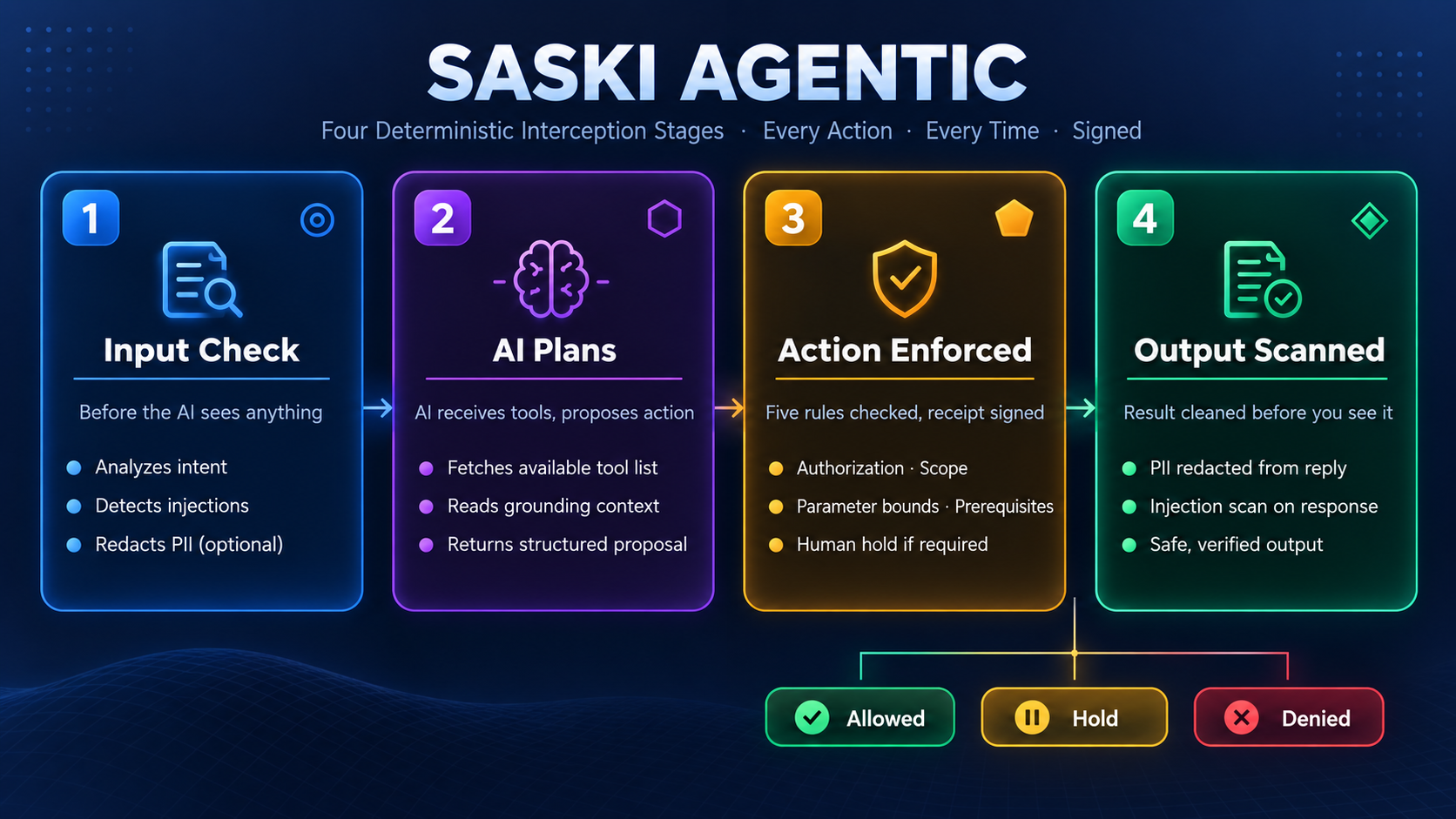
Select the diagram to open the full-size version.
Analyze intent, detect injection attempts, and apply configured PII controls before the agent proceeds.
The agent receives its available tools and context, then returns a structured proposed action.
Authorization, scope, parameter bounds, prerequisites, and holds determine whether the action may proceed.
Apply configured PII and injection checks before returning the result, with evidence retained for the decision.
At the execution boundary
Apply the organization’s rulebook without asking the model to govern itself.
SASKI Agentic scans input, evaluates proposed actions against explicit rules before they touch a connected system, and scans output before returning the result. Your model handles interpretation and planning; your rulebook defines the permitted path.
Each governance outcome can retain an attestation connecting the request, applicable rule, and allow, hold, or deny decision.
Rulebook checks
Check whether the requesting actor is permitted to perform the action.
Evaluate the target, operation, and requested parameters against the allowed scope.
Require applicable conditions and human authorization before execution.
Enterprise example
Illustrative financial workflow. Open the full-size animated visual ↗
A treasury agent proposes a transaction. SASKI applies the organization’s rulebook before any instruction reaches the payment system, then retains signed attestation for the governance decision.
An approved vendor and an amount within the configured ceiling may proceed through the governed path.
A high-value transaction pauses until the rulebook’s required human authorization is received.
An unapproved beneficiary or prohibited request stops before capital is routed.
A governed workflow
The model proposes a response or action but does not authorize itself.
Identity, scope, parameters, prerequisites, and approval requirements determine the permitted path.
The outcome and applied rule are retained as an inspectable governance record.
SASKI separates AI reasoning from authority, then connects the rulebook decision to verifiable attestation.
Designed for operational teams
Apply rulebook governance across enterprise workflows, IT operations, smart buildings, surveillance, access systems, and other consequential environments.
Coverage depends on routing the relevant inputs, actions, and outputs through the governed path. Identify bypass routes, approval handling, failure behavior, and the evidence needed for attestation.
Start with your use case